Intercom vs Drast: When to Use Each (2026 Comparison)
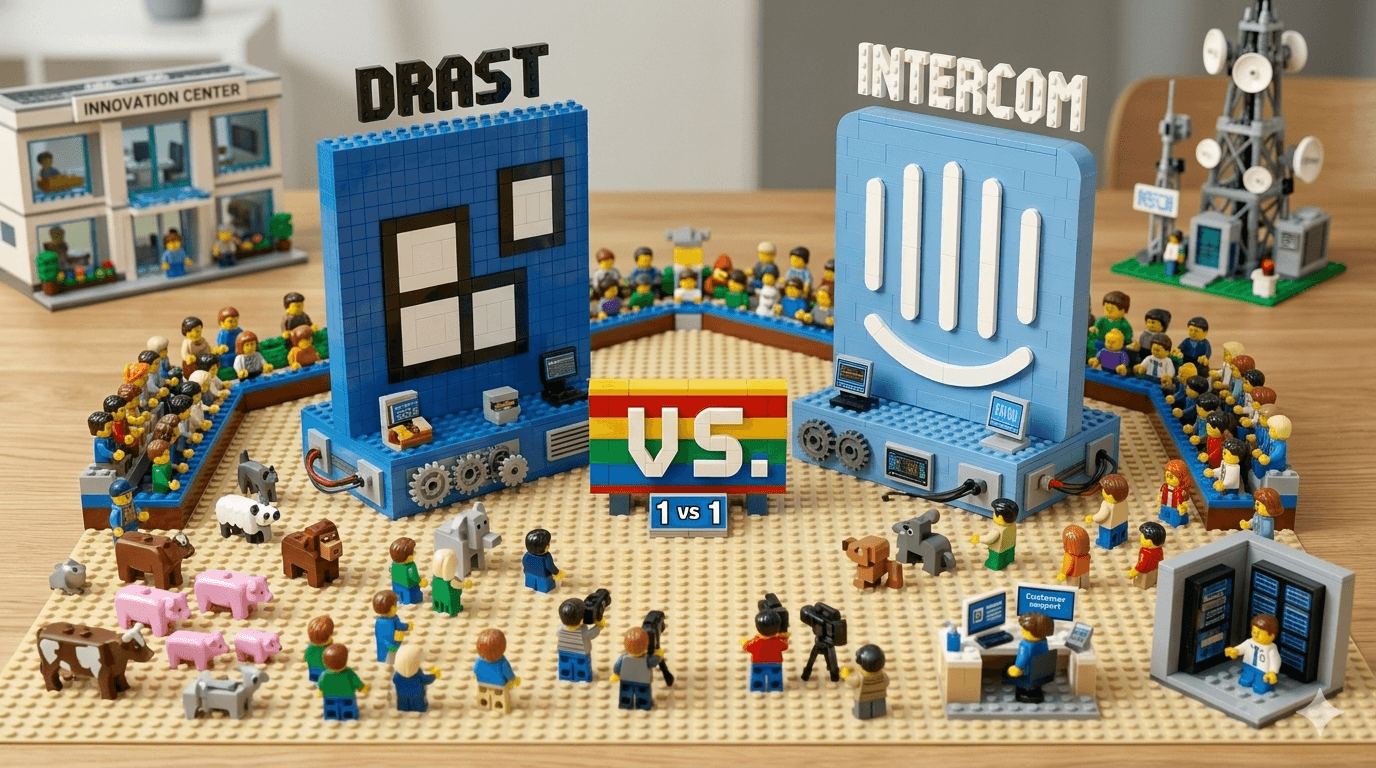
Both tools have a chat bubble on your site. That's where the similarity ends.
Intercom is the market-leading customer support platform. Drast is a purpose-built AI SDR for B2B SaaS websites. They're often evaluated against each other because they look identical on the surface — but they solve completely different problems. Picking the wrong one means either paying for features you don't need or deploying a product that will never hit your KPI.
This article breaks down what each does, where each wins, and the decision framework for choosing one, the other, or both. No vendor bashing — Intercom is excellent at its job, Drast is excellent at a different job, and most B2B SaaS companies will eventually need both.
TL;DR:
Intercom is a customer support platform. Core product: ticket deflection, in-product messaging, help center automation. Fin (their AI) resolves 54-72% of support tickets autonomously.
Drast is an AI SDR for B2B SaaS marketing websites. Core product: anonymous visitor identification, ICP qualification, objection handling, meeting booking.
Use Intercom for post-sale support: tickets, onboarding messages, help center. In-product, for existing customers.
Use Drast for pre-sale conversion: anonymous visitor identification, real-time personalization, qualified meeting booking. On marketing pages, for prospects.
Most mid-market SaaS companies run both. They don't compete — they cover different parts of the funnel.
What each product actually is
Intercom (what they do)
Intercom is the category-leading customer support and engagement platform. Founded 2011, IPO-scale company, trusted by tens of thousands of SaaS businesses globally.
Core capabilities:
Inbox: unified ticket management for email, chat, social
Fin AI: LLM-backed support agent that auto-resolves tickets using your help center and docs
Help center: knowledge base with search and AI answers
In-product messaging: targeted messages to logged-in users (onboarding, feature announcements, churn prevention)
Customer data platform: unified customer profiles across channels
Success metrics Intercom optimizes for: auto-resolution rate, CSAT, response time, ticket deflection, and (increasingly) revenue via outbound product messages.
Drast (what it does)
Drast is a purpose-built AI SDR for B2B SaaS marketing websites. It runs the full inbound sales motion on anonymous visitors.
Core capabilities:
Visitor identification: reverse-IP + enrichment API, identifies 40-50% of anonymous B2B traffic in real time
Silent qualification: scores each conversation against a configurable scorecard (BANT, MEDDICC, or custom)
Objection handling: library-driven responses to pricing, competitor, security, and timing concerns
Meeting booking: direct calendar integration (not "here's a Calendly link")
Slack/CRM handoff: full context pack delivered to the AE before the meeting
Success metric Drast optimizes for: qualified meetings booked + pipeline influenced.
The core architectural difference
Intercom is built for known users with questions. Drast is built for anonymous visitors with intent.
That single distinction cascades through every design decision:
Dimension | Intercom | Drast |
|---|---|---|
Primary job | Deflect tickets, support customers | Book qualified meetings |
Success metric | Auto-resolution rate, CSAT | Meetings booked, pipeline $ |
Deployed where | In-product, help center, logged-in areas | Marketing site (pricing, product, landing) |
Visitor context | Known user → full account history | Anonymous → enriched in real time |
AI's opening move | Ticket classification, FAQ lookup | Personalized by page + enrichment |
Qualifies visitors? | No (user is known and paying) | Yes (against configurable scorecard) |
Objection handling? | Deflects to FAQ / human | Responds with POV (pricing, competitors) |
Books meetings? | Not native — escalates to human | Yes, directly in-chat |
Handoff target | Support agent with ticket | AE with full context pack |
Pricing model | Seat + resolution-based | Per-conversation / tiered |
Who owns internally | CX / Support leadership | Growth / Marketing / RevOps |
Two products. Two jobs. Two KPIs. Two internal owners. They're not interchangeable — and trying to force one into the other's role produces bad outcomes.
When to use Intercom
Intercom is the right tool when:
You need customer support infrastructure. Ticket management, SLAs, escalation routing, agent productivity tooling. This is Intercom's bread and butter.
You want to automate support with AI. Fin AI is genuinely excellent at this — top performers hit 54-72% auto-resolution rates.
You need in-product messaging. Onboarding flows, feature announcements, churn-prevention campaigns for logged-in users.
You have a knowledge base and want AI to answer from it. Help center + Fin is one of the best products on the market for this.
Your CX team needs professional support tooling. Inbox, SLAs, reporting, integrations — enterprise-grade support ops.
Intercom shines post-sale, inside the product, with known users, measured by support KPIs.
When to use Drast
Drast is the right tool when:
Anonymous visitors are your top-of-funnel bottleneck. Traffic bounces without converting, and you can't scale SDRs fast enough to fix it.
You need to qualify visitors before routing to sales. Your AEs are getting too many unqualified meetings and losing trust in inbound.
You want 24/7 coverage on your marketing site. Humans can't staff around the clock. Drast can.
You're running an ABM motion and want real-time signal on target accounts. Drast identifies which accounts visited, what they read, and what they asked.
Your AEs complain about cold-handoff meetings. Drast's context packs eliminate the "who is this?" moment.
Drast shines pre-sale, on marketing pages, with anonymous visitors, measured by pipeline KPIs.
When to use both (spoiler: most of the time)
Most B2B SaaS companies over $5M ARR will eventually need both. Here's the typical stack:
Drast on the marketing site (pricing, product, landing pages) → handles 70-80% of inbound conversations autonomously, qualifies, books qualified meetings, hands off with context
Intercom inside the product (logged-in dashboard, help center) → handles support tickets with Fin, runs in-product messaging for onboarding and retention
They don't conflict. They cover different parts of the funnel. A visitor starts on the marketing site (Drast territory), becomes a customer, logs into the product (Intercom territory). Different product, different conversation, different job.
Attempting to collapse both into one tool — typically by over-extending Intercom into sales or over-extending Drast into support — produces a mediocre version of both. The unified-product pitch is marketing, not architecture.
Pricing comparison
Pricing is structured fundamentally differently, which reflects the architectural difference.
Intercom pricing (2026)
Starter plans start around $39/seat/month (for small teams, limited features)
Advanced plans with Fin AI: $85-$132/seat/month + resolution-based fees (around $0.99 per AI resolution so for each conversation)
Enterprise: custom, typically $200+/seat/month plus usage fees
Scales with your team size and resolution volume
Drast pricing (2026)
Conversation-based tiered subscriptions
Starter: $49/month for ~500 conversations
Growth: $99/month for ~1,500 conversations
Scale: $249/month for ~4,000 conversations
Enterprise: custom, for >10K conversations/month
Scales with your website traffic, not your team size
The key insight: Intercom's pricing grows with your CX team. Drast's pricing grows with your traffic. If you're doing $5M ARR with a 3-person support team and 30K monthly website visitors, Intercom is cheaper. If you're at $10M ARR with a 15-person support team and 15K monthly visitors, Drast is cheaper. Run your own math.
Where Intercom tries to do sales (and why it doesn't quite work)
Fair question: Intercom has "Sales" use cases in their marketing. Can Fin handle inbound sales conversations?
Short answer: it can do basic Q&A on pricing and features, but it's not architecturally built for sales. Here's the gap.
Fin is optimized for resolution. Its training, prompts, and reward function all push toward "close the conversation successfully." In support, that means "user's question answered, ticket closed." Applied to sales, that means "visitor's question answered, conversation ended" — which is the opposite of what you want. You want the sales conversation to continue, surface objections, handle them, book the meeting.
Fin also lacks the sales-specific infrastructure: anonymous visitor identification (it's built for known users), silent qualification scorecards, direct in-chat calendar booking, and Slack context packs for AEs. These aren't features you add on — they're architectural decisions made at product-design time.
This isn't a knock on Intercom. They built the best support platform on the market. It's just built for a different job.
The decision framework (pick one, pick both, pick neither)
Three quick questions to answer.
1. Do you have an active customer base that needs support?
Yes → Intercom is worth evaluating
No (pre-product or very early) → Skip Intercom for now
2. Is anonymous visitor conversion your top-of-funnel bottleneck?
Yes (and traffic > 2K/month) → Drast is worth evaluating
No → Skip Drast for now
3. Do you have budget for both?
Yes, $5M+ ARR → Deploy both, different parts of funnel
Limited budget → Pick the one that matches your biggest bottleneck this quarter, revisit the other in 6 months
What not to do
A few common mistakes when evaluating these two products.
Buying Intercom to do sales. You'll get a support product politely redirecting prospects to docs. The architecture fights you.
Buying Drast to do support. Drast isn't built for ticket management. It'll underperform Intercom on every support KPI because it's not designed for that job.
Treating them as competitors. They're complementary, not substitutes. Evaluating them head-to-head is the wrong framing.
Picking based on price alone. The cheaper tool is irrelevant if it doesn't solve your actual bottleneck.
Trying to unify the experience. The "one chat widget for everything" pitch always sounds better than it performs in reality.
Frequently Asked Questions
What's the difference between Intercom and Drast?
Intercom is a customer support platform optimized for ticket deflection, in-product messaging, and help center automation for known users. Drast is a purpose-built AI SDR for B2B SaaS marketing websites, optimized for anonymous visitor identification, qualification, and meeting booking. They serve different stages of the customer lifecycle — Drast pre-sale, Intercom post-sale — and most mid-market B2B SaaS companies eventually need both.
Can Intercom do what Drast does?
Not architecturally. Fin AI is optimized for resolution (close the conversation), not for sales qualification and meeting booking (continue the conversation, handle objections, commit). Intercom lacks anonymous visitor identification, configurable qualification scorecards, direct in-chat calendar booking, and AE context packs — all of which are core to Drast. You can technically deploy Intercom on marketing pages, but it'll underperform a purpose-built AI SDR.
Can Drast do what Intercom does?
Drast is built for sales, not support. It doesn't have enterprise ticket management, SLA tracking, support agent productivity tooling, or in-product messaging at Intercom's level. If your primary need is customer support automation, Intercom (specifically Fin) is the better tool. Drast complements Intercom — it doesn't replace it.
Which is cheaper, Intercom or Drast?
Depends on your traffic vs team size. Intercom prices per seat plus per-resolution fees, so it scales with your CX team and ticket volume. Drast prices per conversation in tiered subscriptions, so it scales with your website traffic. A small CX team with high traffic pays less for Intercom but more for Drast. A large CX team with modest traffic pays more for Intercom and less for Drast. Run the math on your specific numbers.
Should I use Intercom for B2B SaaS sales?
If your sales bottleneck is anonymous visitors not converting, Intercom isn't the right tool — use a purpose-built AI SDR like Drast. Intercom can handle basic pre-sales Q&A for visitors who've already self-identified (email entered, demo requested), but it's architecturally optimized for support and won't run a full sales qualification and booking motion as well as Drast will.
Do Intercom and Drast integrate?
They operate on different parts of your website (Drast on marketing pages, Intercom in-product) so they typically don't need direct integration — they coexist. Both integrate with your CRM (Salesforce, HubSpot) and Slack, which is usually sufficient. Direct Intercom-Drast data sharing isn't common in standard deployments.
When should I switch from Intercom to Drast?
You don't switch — you add. If you're currently using Intercom for sales conversations on your marketing site, deploying Drast on those pages instead will produce better sales outcomes. Keep Intercom for in-product support. The two tools cover different parts of the funnel and work together cleanly.
Is Drast or Intercom better for small B2B SaaS startups?
Pre-product or under $1M ARR, you probably don't need either. Post-product with customer base, Intercom covers support needs. With 5K+ monthly website visitors and an inbound conversion problem, Drast covers sales needs. Most startups add tools in order: Intercom first (when they have customers), Drast later (when inbound volume justifies AI sales infrastructure).
The bottom line
Intercom wins support. Drast wins sales. Different jobs, different products, different KPIs, different places on your site. Most B2B SaaS companies over $5M ARR will eventually run both — and will get better outcomes doing it than forcing one tool to handle both jobs.
If you want to see how Drast handles the sales side of the funnel, book a demo.