The 5-Stage AI SDR Framework: How to Build One That Actually Books Meetings
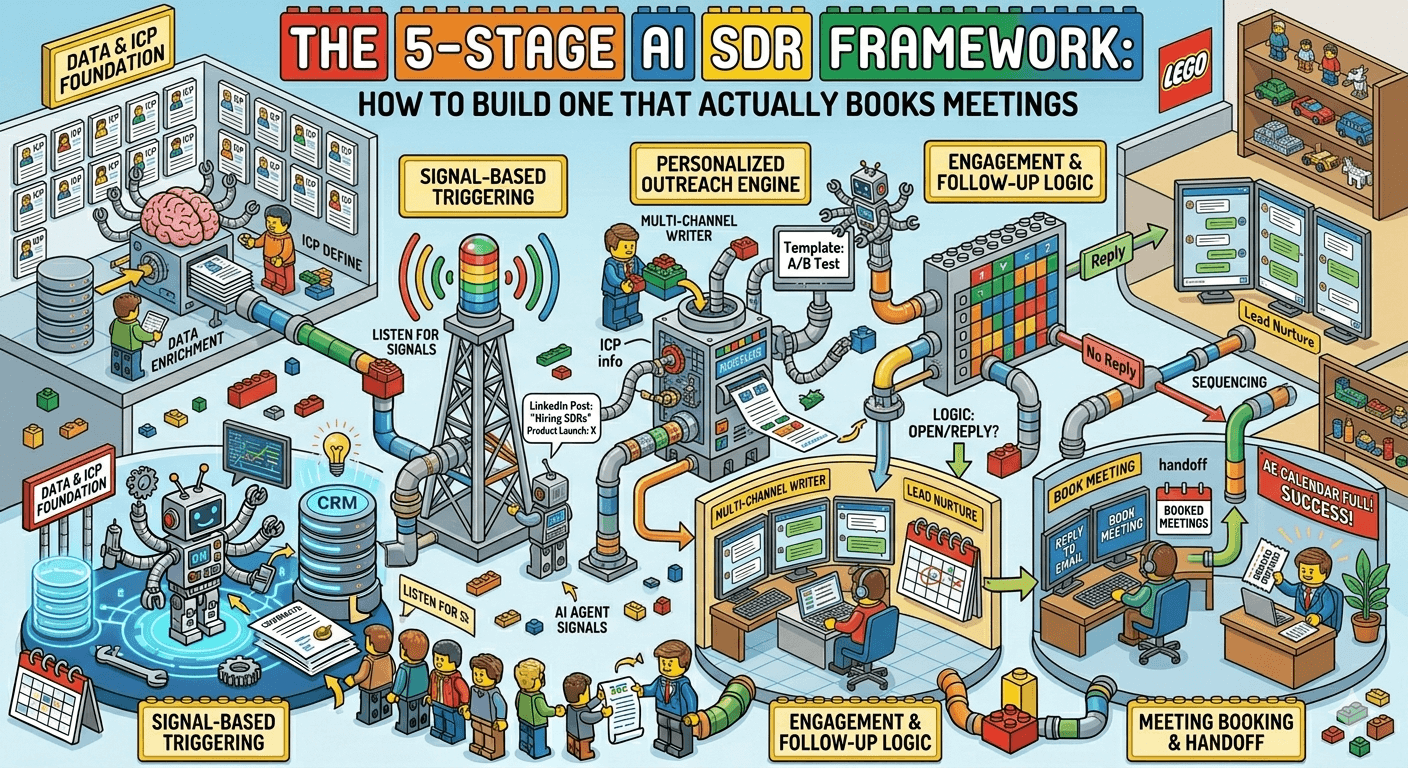
Most AI SDRs fail for one reason: their builders treat them like chatbots with a better hat.
A chatbot's job is to answer questions. An AI SDR's job is to move an anonymous visitor through a sales motion — identify them, qualify them, handle objections, book a meeting, hand off with context. Five stages. Each one needs specific infrastructure. Skip a stage and the bot collapses into either "generic Q&A" or "aggressive form in a chat UI."
This is the framework for building an AI SDR that actually produces pipeline. Use it to evaluate vendors, design your own, or audit whatever's currently deployed on your site.
TL;DR:
Stage 1 — Identification: reverse-IP + enrichment API on anonymous visitors. Target 40-50% identification rate.
Stage 2 — Qualification: silent scorecard (BANT/MEDDICC/custom) run in background, not via interrogation.
Stage 3 — Objection handling: pricing, security, competitors, integrations. The bot needs a point of view, not a FAQ lookup.
Stage 4 — Booking: calendar integration with smart routing. Round-robin, account owner, or enterprise-flag logic.
Stage 5 — Handoff: context pack in Slack/CRM with company, role, intent, objections, questions. Never hand off a naked meeting.
Weakest stage dictates overall performance. Most AI SDRs in market today fail stage 1, 3, or 5.
Stage 1: Identification
Before the bot types its first message, it needs to know who the visitor is.
"Anonymous visitor" in 2026 is a solvable problem for B2B. The stack looks like this:
Reverse-IP lookup — map the IP address to a company. Effective for ~30-40% of US B2B traffic. Weaker for international, VPN-heavy, and mobile traffic.
Domain pattern detection — when the visitor types their email or company URL, parse it immediately.
Enrichment API — once you have a company, enrich with industry, size, tech stack, funding, location. Clearbit, Apollo, or dedicated providers.
LinkedIn enrichment — match the company + behavioral signals to a likely role/contact. Strongest when the visitor has offered any piece of identifying data.
Intent signals — pages visited, session duration, referrer, return visit count.
Top performers hit 40-50% identification on US B2B traffic. Below 30% means the stack is broken — usually a weak reverse-IP provider or missing enrichment API.
What this enables downstream: every other stage. Without identification, the bot is running blind and the quality of everything after collapses. The bot opens cold ("Hi, how can I help?"), qualifies generically, and hands off meaningless meetings.
What to build:
Reverse-IP provider integration (Clearbit Reveal, KickFire, 6sense, or equivalent)
Enrichment API (Apollo, Clay, built-in providers)
Behavioral tracking (page views, time on site, referrer capture)
Account lookup against your CRM (is this a known account? What stage?)
Stage 2: Qualification
This is where most AI SDRs fail by being too aggressive.
The amateur version: bot asks "What's your budget?" in message 2, "How big is your company?" in message 3, "Are you the decision maker?" in message 4. The visitor closes the tab. Qualification happened, meeting didn't.
The right version: qualification runs silently in the background against a configurable scorecard — BANT, MEDDICC, or custom. The visitor never sees the qualification logic. They just see a useful conversation. The bot is scoring them in the background based on:
Identification data: company size, industry, revenue, tech stack (pulled from Stage 1)
Behavioral signals: which pages visited, time on site, return visits
Conversational signals: what they asked, how they phrased it, what objections they raised
Account data: existing pipeline status, prior conversations, previous churn
The scorecard outputs a single binary: this conversation → book meeting or this conversation → hand off to nurture / form / no action.
Configurable scorecard is non-negotiable. Vendor defaults are useless. Your ICP is not their ICP. Build the scorecard with your sales team — what does a qualified meeting look like, specifically, for your business? Who's a waste of an AE's time?
What to build:
Scorecard engine (weighted criteria, real-time calculation)
Scorecard editor your sales team can update without dev work
Logging of every qualification decision for post-hoc review
A/B testing infrastructure for scorecard variants
Stage 3: Objection handling
Where the product reveals itself.
Tell an average AI chatbot "you're too expensive" and it says "Let me connect you with our sales team." That's the moment the prospect disengages. They didn't want a handoff — they wanted a real response.
An AI SDR should handle the top 5-10 sales objections with a point of view. For B2B SaaS, those are typically:
Pricing — "You're too expensive." "What does it cost?" "Do you have a free tier?"
Competitors — "We already use X." "How are you different from Y?"
Security — "Are you SOC 2?" "Where's data stored?" "GDPR compliance?"
Integrations — "Do you work with Salesforce / HubSpot / Slack?"
Timing — "We're not ready." "We're evaluating next quarter."
Scope — "We're too small for this." "We're too big for this."
Authority — "I'm not the decision maker." "I need to check with my team."
Implementation — "How long to get set up?" "How much effort from our side?"
Each objection needs a response that's both helpful and has a point of view. "You're too expensive" shouldn't get "Let me connect you with sales" — it should get "Compared to what? Most teams evaluate us against [competitor], and the ROI comes from [specific lever]. Want me to walk through the math on your use case?"
The objection library is your sales team's brain made reproducible. Build it from recordings of your top AE's calls. Update it weekly based on what's working.
What to build:
Objection library with responses written in your voice
Intent classifier that detects objections from free-form input
Follow-up logic (after objection, what does the bot push toward?)
Escalation rules (if the objection is genuine, hand to human; if it's a test, push back)
Stage 4: Booking
The commit moment. Most AI SDRs fumble this stage by being too passive or too robotic.
The AI SDR should book the meeting directly, not punt to a form. Integration needed:
Calendar: Google Calendar, Outlook, or Calendly API
Routing logic: round-robin, account-owner assignment, or enterprise-flag routing (Fortune 1000 → senior AE, SMB → junior AE)
Availability logic: respect time zones, business hours, AE capacity
Meeting type logic: 15-min intro vs 30-min demo vs 60-min deep dive, based on qualification level
Booking should happen in-conversation. The visitor picks a slot, enters their email, gets a calendar invite — all without leaving the chat.
Common mistake: bots that "send a link" to the visitor instead of booking inside the chat. This adds friction and drops conversion 30-40%. The moment the visitor has to open a new tab, you've lost half of them.
What to build:
Direct calendar integration (not "here's a link to my Calendly")
Routing logic your sales team configures
Time-zone-aware scheduling
Confirmation flow (email + calendar invite + prep materials if enterprise)
Stage 5: Handoff
The most underrated stage. Where most AI SDRs, including expensive ones, fall apart.
A booked meeting without context is a worse outcome than no meeting. Here's why: the AE opens their calendar, sees a meeting they didn't book, doesn't know who the company is, doesn't know what they care about, shows up cold, asks discovery questions the bot already answered. Prospect disengages because they've repeated themselves for the third time. Deal dies.
The handoff must include a full context pack delivered to the rep before the meeting:
Company: name, industry, size, revenue range, tech stack, funding stage
Contact: role, seniority, likely influence level, LinkedIn link
Intent: pages visited, session duration, referrer, return visits
Conversation: full transcript, highlighting objections and key questions
Qualification reasoning: why the bot flagged this as qualified, what scorecard criteria were met
Recommended approach: pricing tier to discuss, objections likely to come up, competitive landscape
Delivered to the rep in Slack DM (ideally), CRM record, and email. Three channels because reps miss notifications — redundancy is safer than elegance.
What to build:
Slack integration with full context pack in the message body
CRM record creation with all context as structured fields
Email summary for AE record-keeping
Pre-meeting nudge (5 min before the meeting, the AE gets a reminder with the top 3 things to know)
How the stages interact
Each stage depends on the previous one. The pipeline is a sequence, not a parallel process.
Break any link and the chain collapses:
Weak identification → generic qualification → wrong ICP qualified → wasted AE time
Weak qualification → bot over-books unqualified meetings → AE trust erodes → nobody uses the tool
Weak objection handling → visitors disengage before qualification completes → meeting never books
Weak booking → high friction at the commit moment → conversion drops 30-40%
Weak handoff → AE shows up cold → prospect repeats themselves → deal dies
Measure each stage independently. Identification rate, qualification accuracy (% of booked meetings that reps confirm as qualified), objection win rate (% of objections that continue conversation), booking conversion (% of qualified visitors who book), handoff quality (AE-rated, 1-5 scale).
The weakest stage dictates the whole system's output. Fix the bottleneck, not your favorite stage.
Common mistakes builders make
Eight traps I see constantly when teams build or deploy AI SDRs.
Treating it as a support bot. Different KPIs, different architecture. Don't retrofit a Fin-style tool for sales.
Skipping identification. Building on top of anonymous visitors without enrichment = cold opens + bad qualification.
Asking qualification questions directly. "What's your budget?" in message 2 kills the conversation. Qualify silently.
No point of view in objection responses. A bot that says "Let me connect you with sales" for every hard question is a liability.
Using seat-based pricing. Punishes you for scaling. Should be per-conversation.
Sending Calendly links instead of booking in-chat. 30-40% conversion drop at the commit moment.
Handoff without context. The AE gets a naked calendar invite and has to do discovery from scratch.
No feedback loop. The bot doesn't learn from meetings that showed up vs didn't, from deals that closed vs died. Build telemetry from day one.
Frequently Asked Questions
What is the AI SDR framework?
The AI SDR framework is a five-stage model for building AI sales development representatives: identification (know who the visitor is), qualification (score them silently against your ICP), objection handling (respond to pricing, competitor, security, and timing concerns), booking (commit the meeting in-chat without handoff friction), and handoff (deliver a full context pack to the AE). Each stage depends on the previous — the weakest link dictates total performance.
How do you build an AI SDR?
At minimum, you need: reverse-IP and enrichment APIs for identification, a configurable scorecard engine for qualification, an objection library trained on your sales team's real call recordings, direct calendar integration for booking, and a Slack/CRM handoff layer that delivers full context packs. Build or buy, but don't skip stages — an AI SDR missing any one of the five collapses into a chatbot.
What's the difference between an AI SDR and a chatbot?
A chatbot answers questions based on docs and owns a deflection KPI. An AI SDR runs a full sales motion (identify, qualify, handle objections, book, hand off) and owns a revenue KPI. AI SDRs use visitor enrichment, silent qualification scorecards, objection libraries with points of view, and calendar integration — capabilities chatbots don't have and weren't designed for.
How do you qualify leads with an AI SDR?
Qualification runs silently in the background, not through direct interrogation. The bot scores each conversation against a configurable scorecard (BANT, MEDDICC, or custom) using identification data (company size, industry), behavioral signals (pages visited), and conversational signals (questions asked, objections raised). Never ask "what's your budget?" in message 2 — infer it from context and only surface qualification through conversation flow.
What qualification framework should an AI SDR use?
Use BANT or MEDDICC as a starting point, but customize heavily for your specific ICP. Vendor-default scorecards are useless because they don't know your business. Build the scorecard with your sales team, weight criteria based on what actually predicts closed-won deals in your data, and update it monthly based on post-meeting feedback from AEs. A scorecard that doesn't evolve is a scorecard that slowly drifts from reality.
How should an AI SDR handle pricing objections?
Never punt with "let me connect you with sales." Instead, respond with context: acknowledge the concern, anchor against competitor pricing or ROI, and offer to walk through the math. Example: "Compared to what? Most teams evaluate us against [competitor] at 2x our price — the ROI comes from [specific lever]. Want me to show the numbers on your use case?" A bot that hands off at every hard question isn't selling, it's triaging.
What does a good AI SDR handoff look like?
A full context pack delivered to the AE's Slack DM before the meeting: company details, contact role, pages visited, session intent, full conversation transcript, qualification reasoning, and recommended talk track. The AE should know everything the bot knows before they say hello. Bots that hand off naked calendar invites produce meetings where the prospect has to repeat themselves — worse outcome than no meeting.
What metrics matter for an AI SDR?
Five stage-specific metrics: identification rate (% of anonymous visitors identified), qualification accuracy (% of booked meetings AEs confirm as qualified), objection win rate (% of objections that continue the conversation), booking conversion (% of qualified visitors who book), and handoff quality (AE-rated 1-5). Weakest metric dictates overall system performance. Track them all, fix the weakest link first.
The bottom line
Five stages. Each one a distinct capability. Build or buy the whole chain — skip a stage and the whole system collapses into a glorified chatbot.
If you want to see the 5-stage framework running in production, book a demo of Drast's AI SDR.