What Is an AI Sales Chatbot And (How Is It Different from a Support Bot) ?
Most B2B SaaS teams buy the wrong chatbot and wonder why their pipeline doesn't move.
They install Intercom Fin, watch it auto-resolve 40% of support tickets, and declare AI chat a win. Meanwhile, 96% of the anonymous visitors on their homepage — the ones with money, intent, and budget — bounce in 12 seconds without talking to anyone. The bot was built to close tickets. The pipeline problem is a different species entirely.
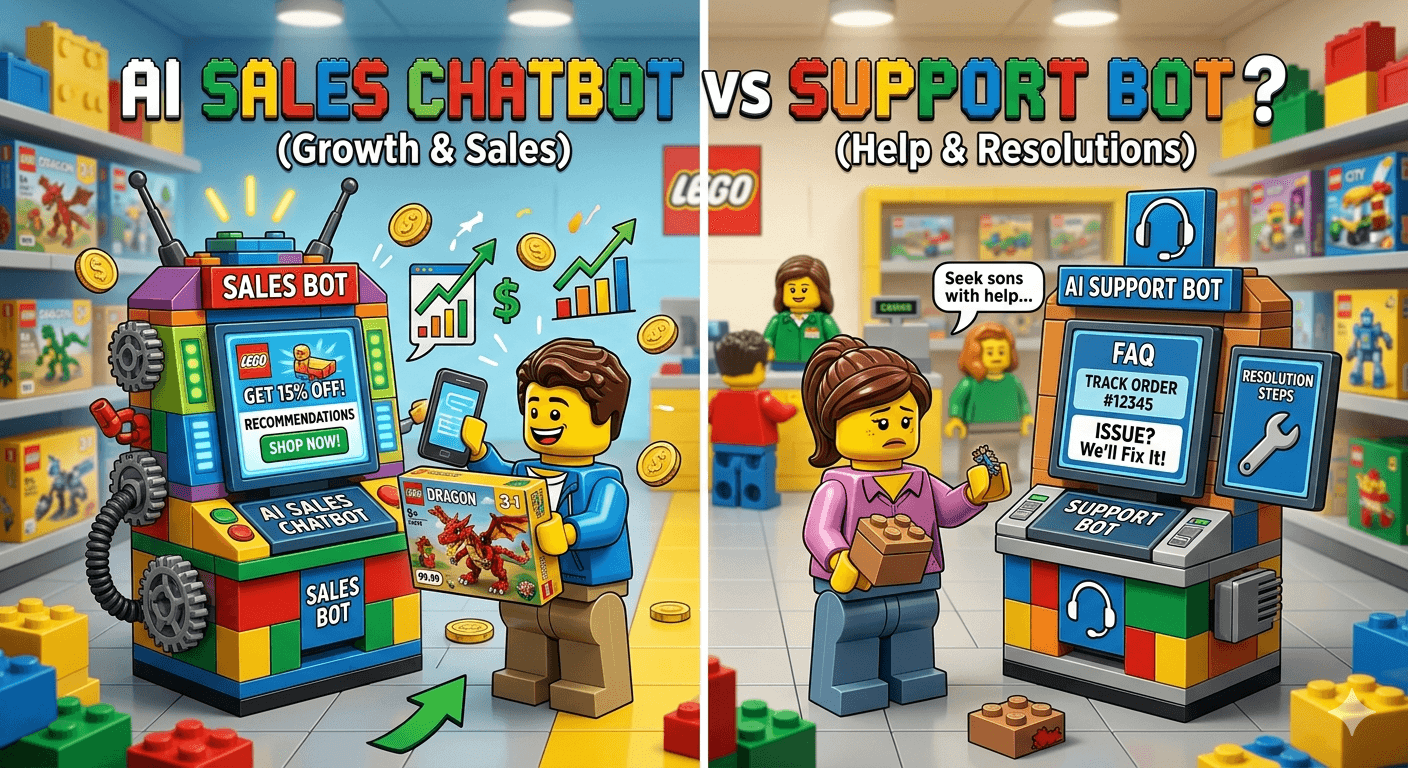
An AI sales chatbot isn't a support bot with a friendlier tone. It's an architecturally different product: different goal, different data sources, different success metric, different place on your site. Confusing the two is the single most expensive mistake in B2B conversion right now. Here's what an AI sales chatbot actually does, why it beats forms, and how to tell if you need one or a support bot (or both).
TL;DR:
An AI sales chatbot is a conversational agent that qualifies anonymous website visitors, handles pre-sales objections, and books meetings — replacing the contact form and most of the SDR outreach stack.
A support bot deflects tickets for existing customers. Different job, different KPI (resolution rate vs meeting-booked rate).
Sales bots live on pricing, product, and landing pages. Support bots live inside the app.
Best-in-class sales bots pull live visitor enrichment (company, role, intent signals) so the conversation opens smart, not "Hi, how can I help?"
If your top-of-funnel bottleneck is anonymous visitors not converting, you need a sales bot. If it's ticket backlog, you need a support bot. Most SaaS companies need both — deployed separately.
What an AI sales chatbot actually does
An AI sales chatbot is a conversational agent deployed on your marketing website whose job is to turn anonymous traffic into qualified pipeline.
That definition matters because every word is load-bearing:
Conversational agent: an LLM-backed interface, not a scripted decision tree. It can handle "what's the difference between your Growth and Scale plan, and does it support SSO?" without a hardcoded flow.
Marketing website: pricing pages, product pages, landing pages, homepage. Not the logged-in app.
Anonymous traffic: visitors you don't know yet. The bot's first job is figuring out who they are.
Qualified pipeline: the output is a booked meeting or a hand-raise from someone who matches your ICP — not a resolved ticket.
The modern version (what some call an "AI SDR") does four things in sequence: identifies the visitor (reverse-IP, enrichment APIs, explicit fields), qualifies against your ICP (company size, tech stack, role), handles pre-sales objections (pricing, security, integrations, competitors), and either books a meeting on your calendar or escalates to a human AE in Slack.
Think of it as Intercom for sales instead of support — same form factor, completely different backend.
What a support chatbot does (and why it's not the same product)
A support chatbot deflects tickets for existing customers.
Its inputs are your help center articles, product documentation, and past ticket history. Its success metric is auto-resolution rate — what percentage of conversations ended without a human agent. Intercom reports Fin AI reaches 54-72% auto-resolution for top performers. That's a support KPI. It has nothing to do with revenue.
A support bot lives inside your app because that's where customers hit friction. "How do I export this report?" "Why is my integration failing?" "Where do I change my billing email?" These are post-sale questions from people who already pay you.
Run this test: if a support bot got 10x better overnight, your CAC wouldn't move. Your churn might nudge, your NPS might nudge, your CSAT ticket volume would drop. But new logo revenue? Untouched. Because support bots operate downstream of the sale.
That's the core difference. Sales bots create revenue. Support bots protect it.
The architectural differences nobody talks about
The two products look similar on the surface — both are chat bubbles in the bottom-right corner. Under the hood, they're wired completely differently.
Dimension | AI Sales Chatbot | AI Support Chatbot |
|---|---|---|
Primary goal | Book qualified meetings | Resolve tickets without human |
Success metric | Meeting-booked rate, pipeline $ influenced | Auto-resolution rate, CSAT, ticket deflection |
Deployed on | Marketing site (pricing, product, landing pages) | In-product, help center, logged-in areas |
Data sources | Website content, sales enablement docs, competitor battlecards, pricing logic, CRM | Help center articles, product docs, ticket history, macros |
Context about visitor | Anonymous → enriched live (company, role, intent, tech stack) | Known user → full account history, plan, usage |
Opening move | Personalized based on page + enrichment | "How can I help?" or ticket classification |
Escalation target | AE or SDR in Slack with context pack | Support agent with ticket thread |
Pricing model | Usually per-conversation or per-booked-meeting | Usually per-resolution or seat-based |
Who owns it internally | Growth / Marketing / RevOps | CX / Support leadership |
Two companies can buy "an AI chatbot" and end up with wildly different products depending on which of these two jobs they're solving for.
Why "just upgrade your contact form" isn't enough
Push back on this one, because every founder I talk to asks: "Can't I just use Typeform + Calendly with some AI on top?"
No, and here's why: forms are a one-shot, visitor-leaves-something-and-waits interaction. A sales bot is a real-time, objection-handling conversation. The gap matters because of how modern B2B buyers behave.
Gartner research on B2B buying shows buyers spend only 17% of their total purchase journey talking to suppliers, and split across multiple vendors, any single vendor gets around 5% of their attention. By the time a B2B buyer fills a demo form, they've already talked themselves in or out of the deal.
A sales bot intervenes earlier. It catches the visitor during evaluation, answers the three questions that would otherwise send them to Reddit or a competitor comparison page, and surfaces intent live. Someone asking "do you integrate with HubSpot and what's the data sync latency?" at 11pm on a Tuesday is a better lead than someone who filled a form saying "interested in a demo."
The contrarian take: the contact form era is dead for anything above $1K ACV. Not because forms don't work, but because they under-qualify and over-delay. A sales bot does both jobs in the same session.
When you actually need a sales chatbot (and when you don't)
Not every B2B SaaS needs one today. Here's the decision tree.
You need an AI sales chatbot if:
You get 5,000+ monthly website visitors. Below that, the bot won't see enough conversations to pay for itself.
Your ACV is above $500/year. Low-ACV self-serve SaaS converts better via free trial, not conversation.
Your top-of-funnel bottleneck is anonymous visitors bouncing, not form fills dying in SDR follow-up.
Your product requires education — compliance, security, integrations, technical differentiation. Anything a prospect needs to understand before booking.
You sell to multiple ICPs and struggle to keep messaging relevant for each.
You don't need one if:
Your product is pure self-serve checkout with no demo funnel
Your main issue is SDR outbound cadence, not inbound conversion
You get <1,000 monthly visitors (work on traffic first)
Your sales cycle is driven by field sales / events / partnerships, not the website
And one more filter: if you have no AE or founder-led sales capacity to handle handoffs, a sales bot will just create booked meetings nobody shows up to. Fix the sales side first.
How to evaluate AI sales chatbots (the 6 things that matter)
Most comparison articles rank vendors. Ignore that — vendors change, features change, pricing changes. Evaluate on architecture instead.
Live enrichment on anonymous visitors. The bot must be able to identify the company (reverse-IP or domain pattern) and enrich the contact (LinkedIn/role/intent data) within the first message. Without this, the bot opens generic. Best-in-class enrichment rates sit in the 40-50% range for US B2B traffic.
Objection handling, not just Q&A. Ask the bot "you're too expensive" and see what happens. A good sales bot pushes back with ROI framing or asks what price would work. A bad one says "Let me connect you with sales."
Real-time access to your CRM and sales data. It should know if this account is already in your pipeline, who owns it, and what stage they're at. Otherwise it creates duplicates.
Configurable qualification logic (BANT, MEDDICC, or custom). You need to tell it what a qualified meeting looks like for your business — not accept vendor defaults.
Clean handoff to Slack / CRM. Every booked meeting should land in your rep's Slack DM with a full context pack: company, role, pages visited, objections raised, questions asked.
Per-conversation pricing, not per-seat. Sales bot ROI is conversation-driven. Seat-based pricing punishes you for scaling traffic.
Watch out for vendors that are actually repositioned support bots with a new landing page. The giveaway: their docs talk about "deflection" or "resolution rate." If those words appear, it's a support product in sales clothing.
What the stack actually looks like in 2026
A working AI sales chatbot sits in the middle of four systems:
Visitor identification layer (reverse-IP + enrichment API like Clearbit, Apollo, or built-in) → turns anonymous IP into company + contact
Intent layer (pages visited, content consumed, time on site, return visits) → scores the visitor
Conversation layer (the LLM + your prompts + your sales enablement docs) → runs the actual chat
Handoff layer (Slack, Salesforce, HubSpot, calendar) → moves qualified conversations to humans
What makes the difference between a working bot and a gimmick is how tightly those four layers are wired. A chatbot with a great LLM but no enrichment layer opens cold. A bot with enrichment but no intent signal asks the wrong questions. A bot that nails both but dumps leads into a lead queue without context loses every handoff.
The category is moving fast. Twelve months ago, the state of the art was "chatbot that answers FAQs." Today it's "AI SDR that qualifies and books." Twelve months from now, it'll probably be autonomous conversational sales that closes sub-$10K deals end-to-end without a human touching them.
How AI sales chatbots change the SDR role
Quick aside, because every founder asks: does this kill the SDR job?
Short answer: it kills outbound-only SDRs. It makes inbound SDRs 5x more productive.
Here's the math. A good inbound SDR books 30-50 meetings a month. An AI sales chatbot on a site with 20K monthly visitors can handle 400-800 conversations and book 40-80 meetings — on autopilot, 24/7. The cost is $0.10-0.15 per conversation, fully loaded. That's a 10-20x cost advantage versus a $70K/year SDR.
But it doesn't eliminate the role — it reshapes it. The SDRs who survive 2026 are the ones who move up the stack: customizing the bot's qualification logic, owning the handoff quality, running account-based plays on the accounts the bot surfaces. Think AI SDR as a tool, not a replacement — the operator who wields it wins.
Frequently Asked Questions
What is an AI sales chatbot?
An AI sales chatbot is a conversational agent deployed on a B2B marketing website that identifies anonymous visitors, qualifies them against your ICP, handles pre-sales objections, and books qualified meetings directly on your sales team's calendar. Unlike traditional chat widgets, it runs on a large language model and pulls live enrichment data on the visitor before the first message.
How is an AI sales chatbot different from a support chatbot?
An AI sales chatbot creates pipeline from anonymous marketing-site visitors. A support chatbot deflects tickets from existing customers inside the product. They have different success metrics (meetings-booked vs auto-resolution rate), different data sources (sales enablement vs help center), and different deployment surfaces (marketing site vs in-app). Most B2B SaaS companies need both, deployed separately.
Can I use the same chatbot for sales and support?
Technically yes, architecturally no. A unified bot will underperform on both jobs because the prompts, data sources, and success metrics conflict. A sales bot that also handles support ends up overly cautious in objection-handling. A support bot that tries to sell breaks the trust it needs to deflect tickets. Pick dedicated tools or split the experience by page (sales on marketing pages, support in-app).
How much does an AI sales chatbot cost?
Modern AI sales chatbots price on a per-conversation or tiered subscription model, typically $99-$599 per month for SMB/mid-market plans with per-conversation costs of $0.10-0.15 all-in. Enterprise deployments with custom integrations run higher. Avoid seat-based pricing — it punishes you for scaling traffic, which is the opposite of what you want.
Do AI sales chatbots actually book meetings?
Yes, but only if three things are true: you have enough qualified traffic (5,000+ monthly visitors minimum), your ICP and qualification logic are clearly defined, and your sales team can actually accept the handoff. Companies that deploy sales bots without fixing qualification logic end up with booked meetings nobody shows up to, which is worse than no meetings at all.
Can an AI sales chatbot handle enterprise deals?
It can handle the first 2-3 conversations of an enterprise deal — qualification, stakeholder mapping, pre-demo objection handling. It cannot close a $500K ARR deal on its own, and shouldn't try. The right framing for enterprise is "AI SDR that surfaces and warms accounts, then hands to AE" — not "AI that closes."
How long does it take to deploy an AI sales chatbot?
A minimal deployment (connect to website, ingest your sales enablement docs, configure qualification logic, test, go live) takes 1-3 weeks if your team has the content ready. The bigger the gap between your current sales motion and the bot's qualification logic, the longer setup takes — because you'll discover your ICP isn't actually written down anywhere.
Will an AI sales chatbot replace my SDRs?
It replaces outbound-only SDRs faster than inbound SDRs. An AI sales chatbot can handle 400-800 inbound conversations per month and book 40-80 meetings at a fraction of SDR cost. Inbound SDRs who move up the stack — owning qualification logic, handoff quality, account-based plays — become more productive with the bot, not displaced by it.
The bottom line
The question isn't "should I use a chatbot" — it's "which job am I solving for?" Sales and support are different products that happen to share a UI. Pick the one that matches your actual bottleneck, deploy it where the bottleneck lives, and measure it on the metric that matches the job.
If your pipeline problem is anonymous visitors not converting, see how an AI SDR qualifies visitors in real time.